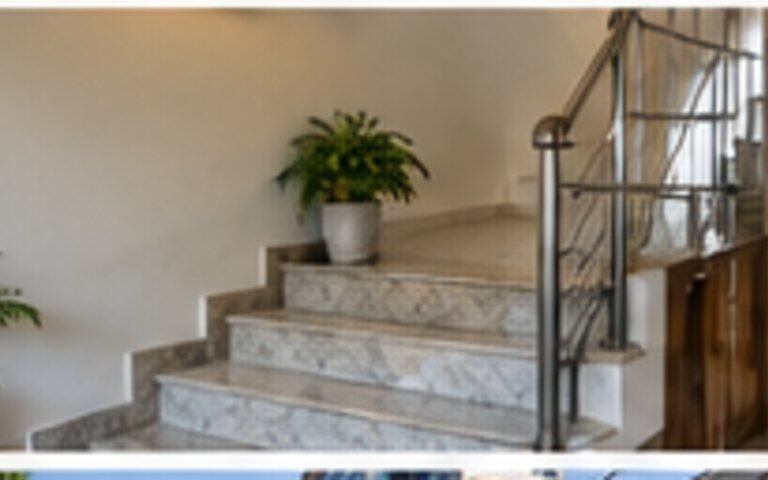
A staircase is used repeatedly but often judged only by its finish. Consistent risers, secure handrails, adequate lighting and visible edges influence safety far more than an expensive stone. In multi-generation homes, the route from street to bedroom should be assessed as one continuous journey.
Check dimensional consistency
A small change between adjacent risers can cause a trip because the body expects a repeated rhythm. Measure suspicious steps, landings and the first and last transition.
Use graspable handrails
A decorative broad ledge may be difficult to hold. Continuous rails should feel secure, remain clear of sharp projections and extend through the important transitions.
Improve edge visibility
Uniform glossy material can make steps visually merge. Contrast, shadow control and even lighting help users identify each tread without creating distracting patterns.
Inspect guarding and openings
Loose rails, low guarding and wide gaps are risks, especially for children. Decorative elements should not create easy climbing points.
Plan for reduced mobility
Consider lift access, entrance thresholds, bathroom location and whether a temporary ground-level sleeping arrangement is possible if stairs become difficult.
Questions to record
Are risers consistent?
Write down the answer during the visit or document review, together with the date and the name or role of the person who supplied it. Mark the answer as observed, documented or unverified. That small distinction prevents a confident statement from being mistaken for independent evidence later.
Can the rail be held continuously?
Ask for an example, document, demonstration or photograph that supports the answer. If none is available, keep the point open instead of forcing a conclusion. A useful comparison sheet should make uncertainty visible and show what must be checked before money or possession changes hands.
Are step edges visible at night?
Test whether the answer would still matter after paint, furniture and presentation are removed from the decision. Permanent constraints normally deserve more weight than replaceable finishes. Record the practical consequence for the buyer, seller, renter or resident rather than simply marking the item yes or no.
Is guarding secure?
Recheck the answer against a second source where the issue affects title, finance, safety, access or a material cost. Current official documents and qualified advice take priority over portal text, an old brochure or an undated message. Save the version used for the decision.
What is the alternative when stairs are difficult?
Before closing the review, write the next action, the responsible person and a sensible deadline. An unresolved question should not disappear inside chat history. A short action log turns the inspection into an editorial record that another reviewer can understand and challenge.
Prepare the draft for review
Keep the evidence file separate from promotional material. Label photographs with the place and date, preserve the original dimensions when an image is used to explain scale, and note any edit that changes brightness or removes a distraction. Ask an editor to check the headline, excerpt, classification, links and image description against the article. If the facts may change, add an observation date and a source that a reader can revisit.
Use the evidence carefully
This draft is educational, not a substitute for legal, financial, structural or valuation advice. Verify changing rules, charges, product terms and property-specific facts with the relevant authority or qualified professional. Date every external figure and distinguish observation, owner statement and independently verified evidence.
Accessibility is not limited to a formal ramp or lift. A safer home is created by many ordinary details that support confident movement every day.
Continue: Browse Architecture & Design or explore the complete SANKUPRA Media story library.